
pa readiness
Damages & Work
Costs & Estimates
Insurance & DOB
Compliance Controls
FEMA Reform
Resource Hub
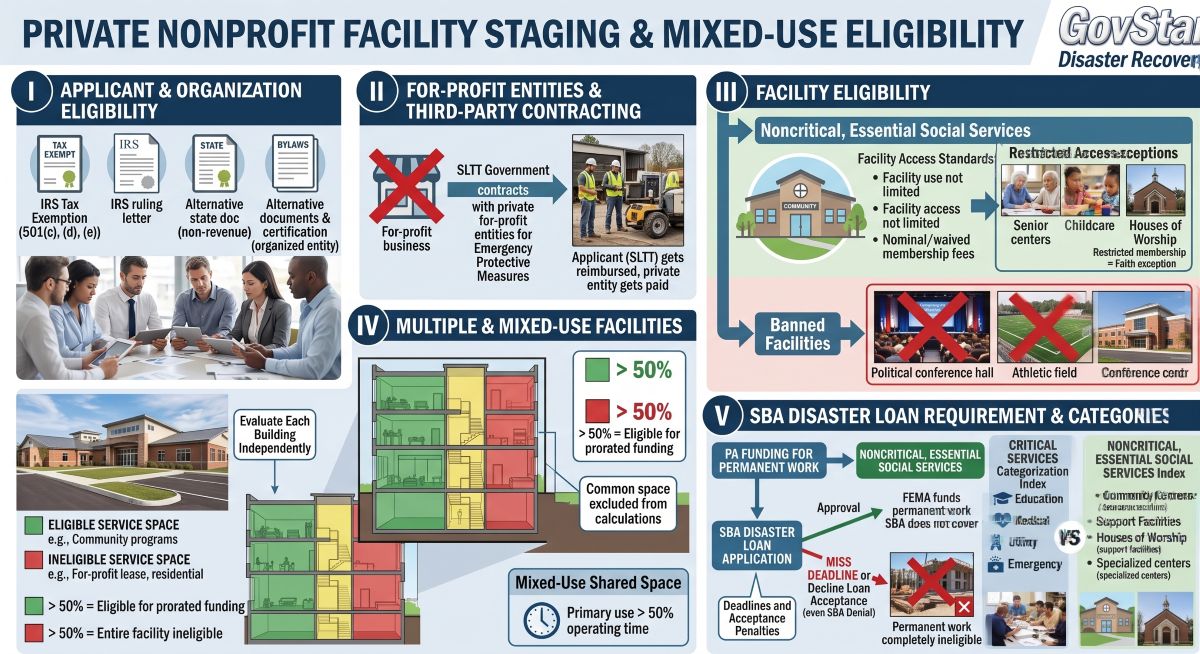
FEMA evaluates a PNP's organization status, and the services provided in each facility owned or operated by the PNP, to determine whether it is eligible. To be eligible, a PNP must have been an established PNP organization, have owned or operated an eligible PNP facility at the time of the incident period, and ensured that the facility provides an eligible service (categorized as either critical or noncritical but essential social services).
For an organization to demonstrate its qualifications as a PNP, it must provide a ruling letter from the U.S. Internal Revenue Service granting tax exemption under sections 501(c), (d), or (e) of the Internal Revenue Code, or documentation from the state substantiating it is a non-revenue producing, nonprofit entity organized or doing business under state law.
Documentation Alternative: If the organization is not required to obtain 501(c)(3) status or tax-exempt status under applicable state law, it must provide articles of association, bylaws, or other documents indicating that it is an organized entity, alongside a certification that it is compliant with Internal Revenue Code section 501(c)(3) and state law requirements.
For-profit entities are strictly ineligible applicants for assistance from FEMA under the PA Program.
Reimbursement Provision: SLTT government entities may contract with private entities, including for-profit entities, to carry out eligible emergency protective measures. In these cases, FEMA will reimburse the eligible applicant for the cost of eligible work, and the applicant may then compensate the private entity for the provision of goods or services.
Prior to determining whether a PNP is an eligible applicant, FEMA must first determine whether the PNP owns or operates an eligible facility that provides an eligible service.
A facility owned or operated by a PNP that provides a noncritical, but essential social service must provide those services to the general public to be eligible. PNP facilities meet the requirement of serving the general public if all the following conditions are met:
Special Facility Allowances: Certain types of facilities that restrict access in a manner clearly related to the nature of the facility—such as senior centers, center-based childcare, custodial care, rehabilitation, or educational facilities—or houses of worship that limit membership to individuals who share a religious faith or practice, are still considered to provide essential social services to the general public.
Facilities established or primarily used for political, athletic, or recreational activities, vocational training, conferences, retreats, or similar activities are ineligible for PA funding.
If a PNP operates multiple facilities, or a single facility composed of more than one building, FEMA must evaluate each building independently, even if all are located on the same grounds. Structures that are part of a complex that includes outdoor facilities (e.g., swimming pools, athletic fields, or tennis courts) are not evaluated separately from the rest of the complex when determining the eligibility of the building.
Eligibility for PNP mixed-use facilities is dependent on the primary use of the facility, which is determined by the amount of physical space dedicated to eligible versus ineligible services. Primary use is the use for which more than 50 percent of the physical space in the facility is dedicated. FEMA evaluates the entire structure when determining primary use; it does not separately address individual areas, such as floors, basements, or wings. Common space, such as bathrooms, hallways, lobbies, closets, stairways, and elevators, are excluded from mixed-use space calculations.
Proration Rule: If FEMA determines that 50 percent or more of physical space is dedicated to ineligible services, the entire facility is ineligible. If the facility is eligible, FEMA prorates funding based on the percentage of physical space dedicated to eligible services. The applicant is responsible for the balance of restoration costs and must restore the entire facility to receive funding for repairs to the eligible-use portions.
In cases where the same physical space is used for both eligible and ineligible services, the primary use is the use for which more than 50 percent of the operating time is dedicated in that shared physical space. If space is available for use, but the applicant cannot support that it is used for eligible services for more than 50 percent of the operating time, this criterion is not met. If 50 percent or more of the operating time in the shared physical space is dedicated to ineligible services, FEMA does not include that physical space when evaluating primary use.
If an eligible PNP leases a facility to another eligible PNP that provides an eligible service in that facility, the facility is eligible. Whichever PNP (the owner or the lessee) has the legal responsibility to maintain the facility under the lease agreement is the eligible applicant.
Following a major disaster declaration, PNPs with facilities that provide noncritical, essential social services must apply for a disaster loan from the Small Business Administration (SBA) and receive a determination before FEMA can provide PA funding for permanent work. FEMA only provides funding for permanent work costs that an SBA loan will not cover.
SBA Framework Constraints: If the PNP misses the SBA application deadline, including any SBA-approved extension, permanent work is completely ineligible for PA funding. If the PNP declines an SBA loan, PA funding is limited to the costs that the loan would not have otherwise covered. This applies even when the PNP cannot accept the terms of the loan (e.g., due to collateral requirements), resulting in an SBA denial.
To be categorized as an eligible critical service, the establishment must fall under one of the following diagnostic categories:
The following establishments are recognized as eligible noncritical, essential social services:
Below are examples of private nonprofit (PNP) facility eligibility determinations that illustrate how the Public Assistance (PA) Program applies primary-use, shared-space, and structural evaluation criteria.
Parkland Hospital is an eligible PNP that owns a medical office building and leases a portion of it to doctors and laboratories that are providing for-profit services. The for-profit leases are for 70 percent of the floor space, excluding the common area floor space, as defined in this policy.
A parking garage is owned by an eligible PNP hospital to support its nearby hospital facility. The ground floor is leased to retail businesses and totals 15 percent of the total space of the garage.
The Woodlands Homeowners' Association is a PNP organization responsible for providing certain localized community services for a 200-home development. The Homeowners' Association is responsible for the neighborhood streets, a water system, a sewage system, a fire station, a medical clinic, a neighborhood park, a community center, and a recreational lake and dam.
The Homeowners' Association provides eligible critical services and therefore operates as an eligible PNP applicant, but the eligibility of each individual asset must be evaluated separately:
Public Access Prerequisite: The community center must be examined closely. If it is primarily used as a gathering place for a variety of social, educational enrichment, and community service activities, it is eligible as a noncritical but essential social service. To preserve eligibility, the facility must serve the general public outside the immediate Homeowners' Association development.
Recreation Exclusion: The neighborhood lake, dam, and park are completely ineligible PNP facilities because they provide primarily athletic or recreational services.
The PNP Springtown Recreation Center claims that it provides eligible essential social services in addition to its recreation activities. The organization notes that its services now include day care for elderly adults, senior citizen center programs, programs for families of domestic abuse, and shelter workshops. These programs are provided by the recreation center staff and offered 5 days a week. Recreational activities are limited to evenings and weekends, though the entire center is used for the eligible services.
Westover Recreation Center sponsors a variety of activities and is available for rental on Friday, Saturday, and Sunday evenings to companies, religious groups, clubs, and civic organizations for league parties, office parties, seminars, conferences, and holiday celebrations. The center has rooms set aside for seniors' bridge and occasional workshops for photography, pottery, ceramics, and art. However, the center is primarily oriented to athletics, featuring a large indoor pool, locker rooms, six squash/racquetball courts, a weight/exercise room, and a 9,200-square-foot gymnasium.
Somerset Community Center consists of several meeting rooms, a lending library, a social services room, a health services room, a dining room, an activity area with games and a wide-screen TV, a darkroom, pianos for practice, a ceramics lab, a woodshop, a computer room, sewing machines, an exercise room, and a large foyer. Outside are a fitness trail, garden plots, an outdoor basketball court, a softball field, a gazebo, and a picnic area. A nominal membership fee is charged, and classes are offered alongside numerous seniors' activities, a senior lunch program, health screenings, immunizations, and door-to-door transportation.
The Community Church operates a state-certified private school offering first through eighth grades. The teaching curriculum includes math, science, English, history, physical education, and religious doctrine. The school has an average attendance of 500 students. The campus consists of three distinct buildings: one used primarily for the secular curriculum, one used primarily for religious instruction, and a chapel primarily used for religious worship. Admissions to the school are restricted to members of Community Church.
FEMA evaluates the three campus structures independently:
SBA Permanent Requirement: Because houses of worship provide noncritical services, the applicant is required to apply for an SBA disaster loan and receive a determination for permanent work on the chapel before PA funding can be obligated.
Nondiscrimination Rule: The school's restricted admissions process does not affect its eligibility. Pursuant to Stafford Act Section 102(11)(B), no PNP facility is excluded from eligibility because leadership or membership in the organization is limited to people who share a religious faith or practice.
A religious institution owns multiple structures within its campus plot. One of the structures is a dock primarily used for recreation. The buildings include a church that provides routine worship services and a separate pastoral residence.
FEMA evaluates the campus elements as independent structures:
Compliance CTA: Confirm applicant eligibility for School Operated by a Religious Institution before project formulation. Document legal status, ownership or operating responsibility, eligible public or PNP service, RPA submission, SBA loan requirement where applicable, and any mixed-use or leased-facility limitations. Keep organizing documents, tax-exempt records, service descriptions, leases, and facility-use evidence in the Grants Portal file.
Compliance CTA: Confirm applicant eligibility for Mixed Use Community Center – Nominal Fee before project formulation. Document legal status, ownership or operating responsibility, eligible public or PNP service, RPA submission, SBA loan requirement where applicable, and any mixed-use or leased-facility limitations. Keep organizing documents, tax-exempt records, service descriptions, leases, and facility-use evidence in the Grants Portal file.
Compliance CTA: Confirm applicant eligibility for Recreational Center – Primarily Athletic Services before project formulation. Document legal status, ownership or operating responsibility, eligible public or PNP service, RPA submission, SBA loan requirement where applicable, and any mixed-use or leased-facility limitations. Keep organizing documents, tax-exempt records, service descriptions, leases, and facility-use evidence in the Grants Portal file.
Compliance CTA: Confirm applicant eligibility for Facilities Owned by PNP Homeowners’ Association before project formulation. Document legal status, ownership or operating responsibility, eligible public or PNP service, RPA submission, SBA loan requirement where applicable, and any mixed-use or leased-facility limitations. Keep organizing documents, tax-exempt records, service descriptions, leases, and facility-use evidence in the Grants Portal file.
Compliance CTA: Confirm applicant eligibility for Support Facility Owned by PNP before project formulation. Document legal status, ownership or operating responsibility, eligible public or PNP service, RPA submission, SBA loan requirement where applicable, and any mixed-use or leased-facility limitations. Keep organizing documents, tax-exempt records, service descriptions, leases, and facility-use evidence in the Grants Portal file.
Compliance CTA: Confirm applicant eligibility for PNP Recreational Center Providing Eligible Services before project formulation. Document legal status, ownership or operating responsibility, eligible public or PNP service, RPA submission, SBA loan requirement where applicable, and any mixed-use or leased-facility limitations. Keep organizing documents, tax-exempt records, service descriptions, leases, and facility-use evidence in the Grants Portal file.
Compliance CTA: Confirm applicant eligibility for Facility Owned by PNP – PNP Leases Portion of Facility to For-Profit Service before project formulation. Document legal status, ownership or operating responsibility, eligible public or PNP service, RPA submission, SBA loan requirement where applicable, and any mixed-use or leased-facility limitations. Keep organizing documents, tax-exempt records, service descriptions, leases, and facility-use evidence in the Grants Portal file.